Waknuk Library Service | Life of an Investigator
OFFICE OF THE LEAD INVESTIGATOR
A peek inside the life of a Waknuk Library Service Investigator while in the field. Contributed by our Lead Investigator, Geoffrey Tarzan Green who now has many years of experience and numerous missions to the Fringes, the Badlands and beyond.


A typical agent field kit
Life in the Field
Field work as an agent of the Waknuk Library Service revolves around the mission objectives, the situation encountered and the resources brought to bear, both from the environment and the indespensible Agent's Field Kit (pictured at left).
The Kit
The Field Kit contains the basic resources brought to every mission with mission specific items usually packaged separately according to their size and other requirements.
The basic kit will contain a disguised EMP generator, a WLS-MOD 3 (Field Frequency Detector), a brass-rimmed magnifying glass, a leather journal, a compact folding grapple hook, a heavy-duty flashlight, forged travel permits, an Investigator ID card, a tactical multitool, data storage cards, a compass, watch, and other personal items all wrapped in a waxed canvas tarp.
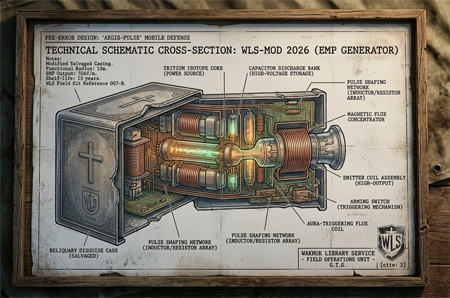
The WLS EMP Generator
WLS Technical Manual: entry #007-B
Subject: Pulse-Relic (EMP Generator)
DEVICE CLASSIFICATION: Non-Lethal Electronic Countermeasure
FIELD DISGUISE: "The Holy Book of the Three" (Standard Magistrate Reliquary)
POWER SOURCE: Miniature Tritium Decay Cell (Shelf-life: 15 years)
1. Overview
The Pulse-Relic is a localized Electromagnetic Pulse (EMP) generator salvaged from Pre-Error urban ruins. It is the primary defensive tool for agents like Geoffrey Tarzan Green when encountering automated Council security or high-level surveillance technology. By emitting a short-burst high-energy electromagnetic field, it temporarily or permanently disables unshielded electronic components within its radius.
2. Disguise & Deception
To a casual observer or a border patrol guard, the device appears to be a common metal-bound prayer book, often embossed with the cross or the "Definition of Man" crest.
- The Trigger: The device is armed by depressing the center of the embossed religious icon.
- The Discharge: The "pulse" is silent and invisible, though it may cause a faint ozone smell and a static "snap" in the air.
3. Technical Specifications
| Feature | Data |
| Effective Radius | 10 meters (Open air) / 3 meters (Through reinforced walls) |
| Recovery Time | 120 seconds between bursts |
| Primary Targets | Automated Turrets, District Communication Hubs, Magistrate Body-Cams. |
| Secondary Effect | Brief interference with the telepathic "thought-shapes" of nearby sensitive individuals (Caution advised). |
4. Operational Guidelines
- The "Final Prayer": Agents are trained to trigger the device while appearing to "pray" over it during an inspection. This provides a cover for the arming motion.
- Sacrificial Use: If the device is detected by a Magistrate’s Geiger counter (due to the tritium cell), the agent should trigger a "burn-out" burst to fry the Magistrate’s equipment and use the confusion to escape.
- Warning: The pulse does not distinguish between friend or foe. It will disable the agent’s own electronic frequency scanners if they are active within the blast zone.
"Faith is our shield, but the Pulse is our sword."
The WLS Frequency Scanner
WLS Technical Manual: entry #007-C
Subject: WLS-MOD 3 (Field Frequency Detector)
DEVICE CLASSIFICATION: Electronic Surveillance / Signals Intelligence Receiver
DESIGNATION: 'WLS-MOD 3' (Waknuk Library Service - Modified)
PRIMARY USER: Lead Investigators (e.g., Geoffrey Tarzan Green)
1. Overview
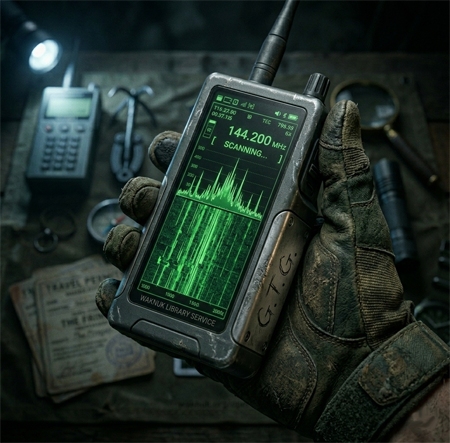
The MOD 3 is a highly sensitive, hand-held frequency scanner used to detect, classify, and track all radio frequency (RF) emissions. While disguised as a basic consumer-grade radio receiver (the generic 'box' you saw in the wide shot), this version has been heavily modified in the WLS Vaults. It features a significantly larger, multi-pane digital display, capable of a live spectrum analysis (shown on the screen below).
2. Key Operational Features
| Feature | Data |
| Operational Band | 100 kHz to 2.5 GHz (Ultra-wide spectrum) |
| Sensitivity | -110 dBm (Capable of detecting whispers over kilometers) |
| Modes | SCAN (Passive automated search), LISTEN (Active monitoring), REC (Capture to memory) |
| Integrated Memory | Uses miniature high-density 'Memory Chips' (see the wide kit shot) |
| Disguise | Features a 'MAGISTRATE MODE' (Press MODE+REC simultaneously) that locks the display to a generic, functional AM/FM dial |
3. Functional Schematic (Close-up visual)
The image above shows the 'MOD 3' in active field use. You can see the complexity of the updated screen:
1. MAIN DISPLAY: A live SPECTRUM ANALYSIS showing three distinct, strong signals (spikes).
2. FREQ READOUT: The main frequency Geoff is focused on: 144.200 MHz (a known District Council security channel).
3. SIGNAL STRENGTH: A clear, scrolling meter, indicating the proximity of the transmitter.
4. INTEGRATED MEMORY: miniature memory chips are inserted into the side slot, marked 'REC' (Recording active).
5. G.T.G. MODIFICATION: Note the small, personal 'G.T.G.' etching on the side of the casing.
4. Operational Guidelines
Agents use the MOD 3 to map the locations of automated security turrets (which emit constant low-power signals), detect the approach of Magistrate patrol vehicles, and identify any "unknown" thought-shape patterns that might indicate a sensitive individual (though this is a secondary, unconfirmed function).